Bass Pale Ale: The Red Triangle That Took an English Beer Global
Before beer brands were global, Bass was already everywhere.
A Burton brewery, a small red shape and a beer that crossed every ocean before its time.
The red triangle of Bass Pale Ale was not just a brewery logo. It was a mark of quality, a Victorian shorthand for a beer drinkers trusted whether they were in Britain, North America, Australia or somewhere else entirely. Beer writer Pete Brown has described Bass as the first big consumer brand and the world's first multinational beer brand. That sounds like mythology until you look at what Bass became.
In the 19th century, Bass Pale Ale travelled the world at a time when global consumer brands barely existed. Its red triangle appeared in bars, adverts, bottle labels and paintings. It was one of the first symbols a drinker could recognise across borders.
But the Bass story did not begin as a neat tale of destiny, water chemistry and world conquest. It began with trade.
A Burton High Street brewery, 1777
Bass is usually dated to 1777, when William Bass bought a brewery on Burton High Street. Even that date is a little tidier than the reality. Bass had already been involved in carrying Burton beer to London and Manchester, and may have had brewing interests before the famous founding date. He did not choose Burton because he understood sulphate-rich water or the future of pale ale. He chose it because it was home, because it sat between important markets, and because the canals made it useful.
Only later would Burton's water become the thing that changed everything.
Britain's industrial brewers
Britain in the late 18th and early 19th century was in the middle of the industrial revolution, and brewing was part of it. Breweries were early adopters of steam power, hydrometers, microscopes and process control. They were not quaint back-room operations. They were among the great technical businesses of the age.
The first truly industrial beer was porter. London's porter breweries used scale to change the economics of beer. Instead of pubs brewing their own, it became cheaper and more reliable to buy from large specialist breweries. Porter became the beer of the industrial revolution.
Burton's path was different. It was a small inland town, but it had a reputation for beers that travelled and kept unusually well. Its early fame was for Burton brown ale, a sweet, nut-brown beer sent to the Baltic and Russia. But Burton's future would be pale.
The water changed everything
Burton water is hard and rich in sulphates, especially calcium sulphate, or gypsum. That minerality sharpened bitterness, dried the finish and helped create the vivid snap that made Burton pale ales so distinctive. Brew the same hoppy beer in London and Burton, and the Burton version tasted brighter, drier and more alive.
There is a perfect brewing legend about how pale ale found its way to Burton. The chairman of the East India Company supposedly fell out with Hodgson, the London brewer whose beer was being sent to India. He took Hodgson's beer to Samuel Allsopp in Burton and asked if he could brew something similar. Allsopp did, and his beer worked better. The recipe suited Burton water far more than London water, and Hodgson was soon pushed aside.
At first, this beer was simply pale ale. The name India Pale Ale only began appearing in the early 1830s. But India had a powerful hold over Britain. Civil servants and merchants returned from the East India Company rich, nostalgic and culturally changed. Newspaper adverts began selling India Pale Ale as the beer they had drunk overseas, now available at home.
Bass then entered the pale ale story and grew bigger than Allsopp. It had the water, the technology, the scale and eventually the branding. It also had the right beer for the right moment.
Coke malt, clear glass, and the look of progress
Technology changed how beer looked as well as how it tasted. Older malt was often dried over wood or hay, which could leave smoky flavours. The development of coke — coal with the gases burned out — allowed maltsters to control heat more precisely. That made pale malt possible at scale, and pale ale followed.
Then came glass. When taxes on glass were reduced in the 1850s, drinkers increasingly moved from pewter tankards to clear glasses. Suddenly the look of beer mattered in a new way. Dark beer had hidden in metal. Pale ale shone in glass. Bass was bright, bitter, sparkling and pale. It looked like progress.
A city-within-a-city
At its height, Bass was not simply a large brewery but an industrial estate. Burton became a landscape of maltings, wells, cellars, steam power, cooperage, railway links, union rooms and distribution networks. This was British brewing at imperial scale: part brewery, part city-within-a-city.
The pale ales that made Bass famous were not like modern cask bitters. They were brewed strong, heavily hopped, and then aged until they were ready. Contemporary drinkers talked about beer being ripe or not ripe yet, as if it were fruit, cheese or wine.
That ripening could happen at sea. Beer bound for India might spend six months travelling by ship, conditioning as it went. But beer that stayed in Britain was aged too. St Pancras Station in London was built with vast undercroft cellars that stored hogsheads of Burton IPA. If the beer did not go abroad, it could sit beneath London for a year before being served.
The flavour would have been very different from modern Bass. It was probably firm, bitter and malt-led rather than aromatic in the modern hop-forward sense. There may also have been Brettanomyces character. This was brewing before pasteurisation and before modern microbiology. A little Brett could have given the beer a dry, vinous, almost champagne-like edge, which helps explain why Victorian writers so often compared great pale ale with sparkling wine.
So what happened to that beer?
In short: tax, labour, war and changing drinking habits.
For much of the 19th century, beer was still part of the working day. Manual workers might drink several pints while working. But as Britain moved towards office jobs, clerks and salaried workers could not drink seven or eight pints a day and still function. Beer had to become lighter.
Tax pushed it further. In the 1860s, beer duty was revised so that beer was taxed according to strength. Almost immediately, average beer strength fell. Then the First World War drove strengths down again through raw material shortages and government concern about drunkenness among factory workers. Beer fell below three percent in many cases, and remained weak through much of the 20th century.
Bass evolved through the same forces. The strong, aged, export pale ale became a fresher, weaker, live cask beer. With the development of microbiology and a better understanding of yeast, beer changed again. Instead of long ageing and shipping, drinkers increasingly encountered living beer from hand pumps: fresh, bitter, lightly sulphurous and recognisably Burton.
That sulphurous note became known as the Burton snatch. Harry White, who joined Bass in 1977 and later became Director of Quality Assurance, describes the old Burton character as something you could smell as well as taste. It was yeast, sulphur, fermenting rooms, carbon dioxide, alcohol, boiling wort and living beer. It was not always neatly controlled, but it gave the beer character. It made it special.
Bass Charrington and the rest of the empire
By the time White arrived in Burton in January 1977, Bass was no longer simply the old Victorian pale ale brewery. It was Bass Charrington: a national brewing company created through mergers with Mitchells & Butlers, Charrington, Worthington, United Breweries and the lager ambitions that brought Carling Black Label into the story. The Bass name survived because it carried the deepest prestige, but the company beneath it was a patchwork of older brewing empires.
On paper, it was a modern brewing giant. In reality, it was still learning how to be one.
White joined the R&D department in Burton High Street, close to the breweries themselves. Bass still occupied a large part of the town: breweries, maltings, distribution yards, water systems and engineering infrastructure. Burton was not a town with a brewery. It was a brewing town.
Where are they now?
The end of the Bass empire is, in some ways, the most familiar chapter — a slow dismantling carried out by other people's mergers and other people's competition lawyers. The skeleton of the story has been told most usefully by London beer writer Des de Moor.
In one of the big brewers' earliest moves to dismantle their capacity in London, brewing ceased at the Anchor Brewery in Mile End entirely in 1975, though the brands remained available for a while with production transferred to M&B in Birmingham. Bass Charrington retained the brewery offices for some years as their London headquarters; the site was largely redeveloped as the Anchor retail park in the 1980s.
In 2000 the brewing interests of Bass Charrington were sold to Interbrew of Leuven, Belgium, which has since become AB InBev following mergers with Brazil's AmBev and St Louis–based Anheuser-Busch. Following intervention from the European Union competition regulator, the Burton brewery and some of the brands including Charrington were sold on in 2001 to Coors of Golden, Colorado — now Molson Coors.
Toby Bitter, in keg and occasionally even in cask, continued to appear intermittently, sometimes contract-brewed, and in the 2020s is still available as a keg product, though at an even lower strength of 2.8% ABV. Toby Ale was brewed by Molson in Québec at least into the mid-2000s (historically Molson was a rival to Canadian Breweries but had merged with its successor company Carling O'Keefe in 1989).
Charrington IPA was recreated in cask and bottle with the consent of Molson Coors in 2015 by Steve Wellington at the Heritage Brewing Co in what was then the National Brewery Centre — the former Bass Museum, in Burton upon Trent. It has since become part of the regular range, using a vintage recipe at a respectable 4.5% ABV and the original Charrington yeast strain. Heritage subsequently revived another Charrington brand, Oatmeal Stout (4%).
The former Bass Charrington pub arm eventually renamed itself Mitchells & Butlers after the Birmingham brewery, which was closed by Coors in 2002.
Bass today: not dead, just difficult
Bass should probably have disappeared by now. It is a tiny brand compared with what it once was, barely visible in the portfolio of the multinational that owns it, and completely detached from the old Bass company that made its name. Yet it keeps refusing to die.
That is because Draught Bass has become something stranger than a normal legacy beer. It is a cult cask ale: loved by drinkers who know where to find it, discussed obsessively online, and still capable of stopping a pub conversation when a pint is properly kept.
Its modern distribution is patchy rather than national in the old Bass sense. Phil Mellows, writing for Pellicle in "No Treble — The Inextinguishable Appeal of Draught Bass", describes Draught Bass as a regional survivor: strongest in the East Midlands, especially Staffordshire, Derbyshire and Leicestershire, with trails into the West Country, Wales and scattered outposts elsewhere. In 2018, Ian Thurman and other Bass drinkers began crowdsourcing sightings because they feared the beer might disappear. They found only around 350 pubs with Bass permanently on the pumps. The list is still maintained, and drinkers still use it like a treasure map.
That drinker network matters. National Bass Day, Best Bass in Burton, the Facebook group, the Honourable Order of Bass Drinkers — these are not normal brand activations. They are drinkers doing the work a brewer would usually do. Bass has become a beer kept alive by the people who love it.
But the number of places serving it has been rising again. Roger Protz reported in late 2025 that Draught Bass had passed 1,000 outlets, with numbers almost trebling over two years after renewed support from AB InBev. The irony is pure Bass: the brand is owned by AB InBev, brewed in Burton for a global rival, and kept alive by cask drinkers who care about it far more than corporate logic says they should.
What does it taste like today? At its best, it is not spectacular in the modern craft sense. It is better than that. It tastes like the ideal version of an English bitter: dry, gently fruity, bitter at the finish, with caramel malt through the middle and, when fresh, a sulphurous Burton nose that can fade as the cask settles.
Ron Pattinson's brewery notes capture that split beautifully. A cask open for a few days was dry, bitter and clean. A freshly tapped sample was fuller of sulphur, softer in perceived bitterness and more obviously Burton. Later, in the pub, the sulphur had mellowed and the beer had become exactly what Bass drinkers chase: dry, bitter, balanced and deeply drinkable.
That is the point. Draught Bass is not great because it is dramatic. It is great because, when looked after properly, it disappears too quickly. The first sip has texture and fruit, the middle has malt, the finish has bitterness, and then somehow the glass is empty.
Some Bass pubs have become minor pilgrimage sites: the Coopers Tavern in Burton, Dyffryn Arms in Pembrokeshire, the Sun Inn in Stockton-on-Tees, the Express Tavern by Kew Bridge, and Burton pubs such as the Roebuck and Devonshire Arms. The geography is uneven, but that is part of the appeal. Finding a good pint of Bass still feels like finding something.
Draught Bass also has its own folklore. It comes in 10-gallon casks rather than standard nine-gallon firkins. Some publicans and former Bass people say it benefits from time in the cellar to round off; Harry White disputes the mythology, arguing that Bass was designed to be robust and reliable by the time it reached the pub. Either way, the argument is part of the beer now.
Perhaps that is why modern Bass is so compelling. It is owned by a global brewer, brewed under contract, barely promoted, regionally scattered and technically diminished from its Victorian ancestors. Yet somehow it has wriggled loose. Draught Bass may now belong less to its owner than to the drinkers who know where to find it.
What the red triangle still means
Most British beer brands you see today are descended from companies that no longer exist, owned by companies who didn't make them, brewed under licences signed in boardrooms half a world from Burton. That is the rule, not the exception. Bass is just an unusually clear example of the rule, because the brand outran the brewery so completely. The Anchor Brewery is a retail park. The Burton brewery belongs to Molson Coors. The brand belongs to AB InBev. Draught Bass is contract-brewed back in Burton. The pubs are listed on the London Stock Exchange under the Mitchells & Butlers name. The Charrington IPA in your hand was probably brewed in a heritage line at the old Bass Museum, using a yeast strain that survived the company that bred it.
And the red triangle still works.
It works because it had to do its job before logos were everywhere, before brand managers were a profession, before global consumer marketing existed as a category. It had to be legible across language barriers, across the print quality of a Victorian advertisement, across the side of a wooden cask and the corner of a Manet painting. It was already doing all of that in 1882, the year Édouard Manet finished A Bar at the Folies-Bergère and put two bottles of Bass — red triangles plainly visible — on the bar in front of the barmaid. That painting now hangs in the Courtauld in London. The triangle in it predates the modern brewery industry by a hundred years.
The triangle then turned up in at least forty Picasso works. One of them — Bottle of Bass and Glass, an enamel-and-oil canvas Picasso painted in Paris in the spring of 1914 — was accessioned into the Metropolitan Museum of Art's modern and contemporary collection in 2025. The BBC's survey of logos that became legends places Bass in the company of Twinings, Levi's, Peugeot, Heinz and Shell — brands old enough that their marks read as cultural artefacts rather than corporate signatures.
The triangle was also the calling card of a brewery that held a Royal Warrant. From the late Victorian era through to the middle of the twentieth century, Bass were Brewers to the Royal Household — a status they advertised on millions of bottle labels and, for the pub trade, on framed mirrors that brewery reps gave to publicans to hang behind the bar. The "By Appointment / Brewers to the King" wording on a mirror dates it to one of four reigns — Edward VII (1901–10), George V (1910–36), Edward VIII (1936) or George VI (1936–52). Many survive in working pubs.
One hangs on the wall at The Craft Beer Co. St Mary's Axe in the City of London, watching over a tap wall that doesn't include Bass.
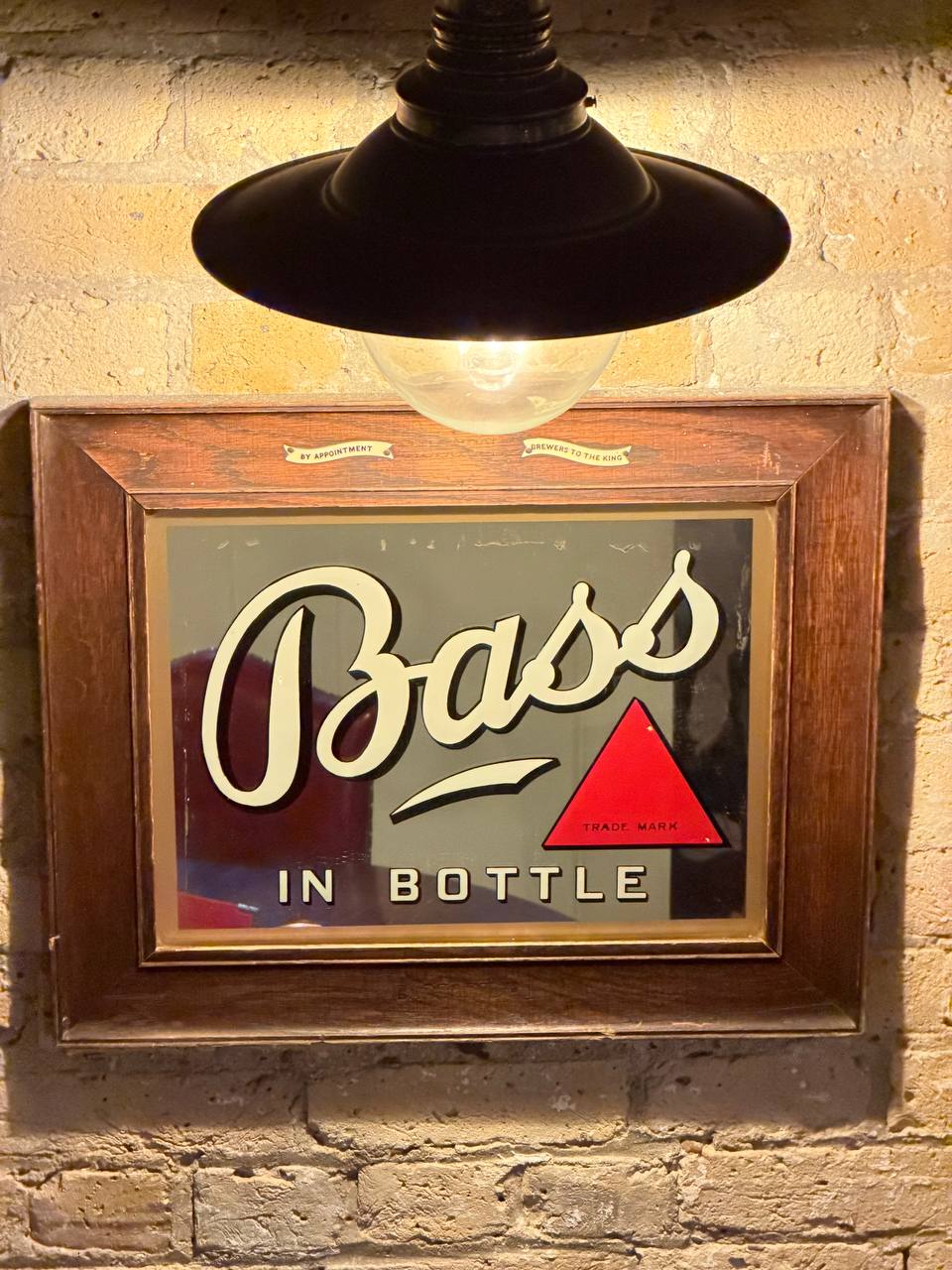
A beer can outlive its company. A glass shape can outlive a tax law. A taste can outlive a generation. Some things stay. The triangle is one of them.
FAQ
Why is the red triangle on Bass Pale Ale famous?
Bass registered the red triangle as the United Kingdom's first registered trade mark on 1 January 1876. By that point it was already in use on bottles, casks and adverts, and had travelled the world along with the beer. Pete Brown describes Bass as the first big consumer brand and the world's first multinational beer brand.
Why did pale ale come from Burton upon Trent?
Burton's well water is unusually rich in sulphates, especially calcium sulphate (gypsum). That sharpens bitterness, dries the finish and pushes hop character forwards. By the 1820s, breweries elsewhere were physically copying Burton's water with mineral additions — a process still called Burtonisation.
Who owns Bass now?
The Bass brand is retained by AB InBev. The historic Burton brewery passed to Coors — now Molson Coors — after the 2001 competition ruling. Draught Bass has since been contract-brewed in Burton, in Burton at the former Marston's brewery, now under Carlsberg ownership. The old Bass pub estate became Mitchells & Butlers.
Is Draught Bass still brewed?
Yes. Draught Bass survives as a 4.4% cask beer, brewed in Burton under contract for AB InBev. Its availability is patchy but improving: strongest around the Midlands and parts of the North, with occasional sightings elsewhere. Recent reports put it in more than 1,000 outlets, helped by renewed trade support and a loyal drinker following.
A separate Charrington IPA was recreated in 2015 by Steve Wellington at Heritage Brewing Co in the former Bass Museum, using a 4.5% ABV vintage recipe and the original Charrington yeast strain.
What does Draught Bass taste like today?
At its best, Draught Bass is a classic English bitter: dry, gently fruity, caramel-malted and firmly bitter, with a sulphurous Burton note when fresh. That sulphur softens as the cask settles, leaving a drier, balanced beer that drinks easily. Ron Pattinson's notes describe the same cask changing from sulphurous and full when freshly tapped, to clean, dry and deeply drinkable later in the pub.
Kept properly, the glass empties without you noticing — which is the whole point.
What is the "Burton snatch"?
A subtle sulphurous note in Burton-brewed beer caused by the area's hard, sulphate-rich water. It is the smell of the brewery as much as of the beer — yeast, sulphur, fermenting rooms, carbon dioxide and wort. For many drinkers it is the defining marker of a genuine Burton ale.
A Victorian beer brand that survived its own brewery. The triangle is still on the label. Most of the rest is rearranged.
For more on the brewing forces that shaped (and weakened) British pale ales — strength taxes, glass duty, sparkler bias — see the companion essays below.
The Sparkler Question — the small nozzle that re-shapes a cask pint and still divides drinkers north and south.
Sources
- Pete Brown, Hops and Glory (Pan Macmillan, 2009) — for the IPA-to-India journey.
- Martyn Cornell, Amber, Gold and Black (The History Press, 2010) — for the chronology of British beer styles.
- Boak & Bailey, Bass Recipe Uncertainty — boakandbailey.com, on the difficulty of saying what Victorian Bass actually tasted like.
- Boak & Bailey, Where Bass Is From — same site, on the Burton geography and water question.
- The Beertonian, Early Bass History — for the William Bass trade-and-transport origin story.
- Beervana (Jeff Alworth), Classic Bass and the Brewery Scale — for the city-within-a-city framing.
- Bailey's Beer Blog, The Rise and Demise of Bass — for the strength fall through the 20th century.
- Harry White, former Bass R&D and Director of Quality Assurance, in conversation on the "Burton snatch" and 1977 Burton.
- Bass Brewery (Wikipedia) for the corporate timeline.
- Burton upon Trent (Wikipedia) for the brewing-town geography.
- Édouard Manet, A Bar at the Folies-Bergère (1882) — Courtauld Gallery, London.
- Pablo Picasso, Bottle of Bass and Glass (Paris, spring 1914) — enamel and oil on canvas, accession 2025.616.4, Metropolitan Museum of Art, Modern and Contemporary Art.
- Anna Bressanin, "The logos that have become legends" — BBC Worklife, 17 November 2017, on Bass as the oldest registered UK trademark and its place alongside Twinings, Levi's, Peugeot, Heinz, Shell.
- Bass "By Appointment / Brewers to the King" pub mirror — vintage Royal Warrant point-of-sale advertising, observed at The Craft Beer Co. St Mary's Axe, 29-31 Mitre Street, London EC3A 5BU, June 2026. Photograph held in PINtPRESS editorial.