Purl ahoy!
Winter Warmer: a name, not a temperature. We mull wine and cider, but beer was once served hot. What it was, and where it went.
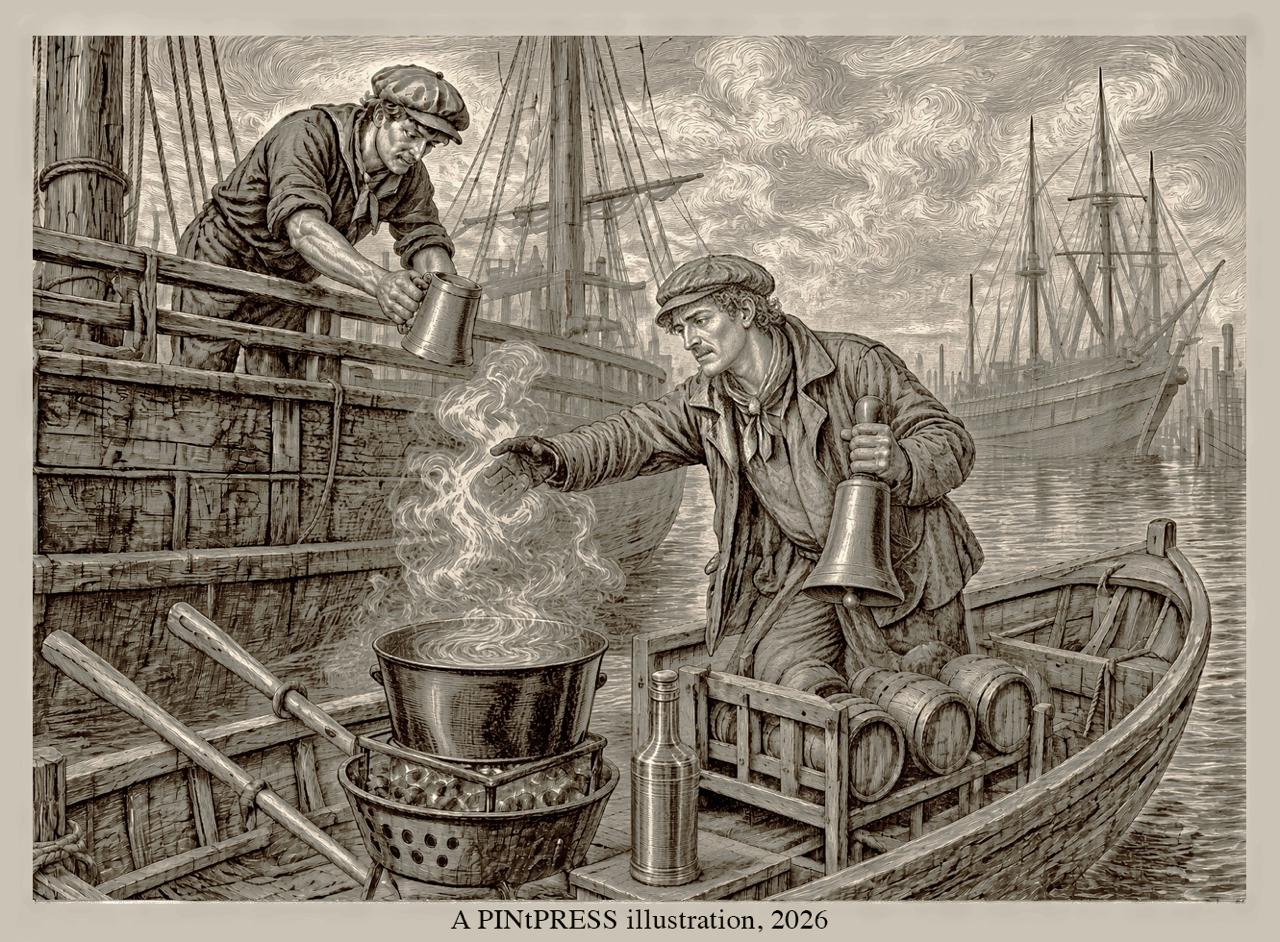
Before dawn, in the Pool of London, a man rowed out to the ships with a fire burning in the bottom of his boat.
He was selling hot beer. In 1851 Henry Mayhew counted men like him and wrote the chapter up as a trade rather than a curiosity, Of the River Beer-Sellers, or Purl-Men: what a boat cost, what a licence cost, who bought. They worked in short, broad skiffs, rang a heavy bell as they came, and were hailed from the ships by sailors and coal-whippers with a shout of “Purl ahoy”. They were licensed from Waterman’s Hall, like the watermen themselves. He counts them too: thirty-five purl-men left on the river, twenty-three of them in the Pool between Execution Dock and Ratcliff Cross among the coal ships, eight working up to London Bridge, and four below Limehouse Hole where the colliers lay waiting to be sold on the Coal Exchange.
The men in the boats were no longer what Mayhew calls “the weather-beaten tars who in former times alone were licensed”. He found the trade had passed to young men off the river itself, come to it “either from some accident having befallen them in the course of their work” or from preferring a seat in a boat to continuous labour. The trade held because no man working the river would buy from a stranger when his own fellow-workman was afloat and would give him trust when he had no money. It was no unusual thing, he says, for the busiest of them to take a public-house after four or five years and rise into the rank of licensed victuallers. One purl-man Mayhew talked to had been a coal-whipper himself, until he fell from a ship’s side into a barge, spent a long time in hospital, came out unable to work and saw nothing in front of him but the workhouse. “I thought I’d be by this time toes up in Stepney churchyard,” he said, “and grinning at the lid of an old coffin.” A neighbour, a waterman, advised him into the purl business and gave him the money to start. He cleared eighteen to twenty shillings a week, and was owed between ten and twenty pounds he never expected to see.
In winter fog, when the watermen lost their bearings and shouting got them nowhere, the purl-man’s bell still carried, and by sounding it he found the ships that hailed him. Boak & Bailey went through the same chapter in 2018 and followed the boats further than we are going to here.
What was in it
What was in the pot had already changed by the time Mayhew got there. Purl had been ale with wormwood in it, bitter and medicinal, although Mayhew could not say why that was called purl: he notes only that the philologist Nathan Bailey used the word that way. By 1851, Mayhew writes, “the wormwood is unknown; and what is sold under the name of purl is beer warmed nearly to boiling heat, and flavoured with gin, sugar, and ginger”. Bailey’s dictionary of 1721 had no such trouble with flip, which it gives as “a sort of Sailor’s Drink, made of Ale, Brandy, and Sugar”.
The receipt for common purl that John Bickerdyke printed in 1889 runs to Roman wormwood, gentian root, sweet sedge, snake root, horseradish, dried orange peel, juniper berries and the kernels of Seville oranges, all left standing in beer for some months, and the writer he had it from thought a pound or two of galingale would improve it.
Purl was not the only ale with a herb cupboard in it. William Butler, physician at the court of James I, gave his name to a purging ale made, by the account Ivan Day traces, by hanging a canvas bag of senna, polypody of oak, agrimony, maidenhair and scurvy grass in a barrel of strong ale, and sold, the story goes, only by taverns licensed to hang his head on the sign. Gregg Smith counts it among the hot spiced beers of the early 1600s. One of those taverns is still open: the Old Doctor Butler’s Head in Mason’s Avenue, off Moorgate, on a site that has had a pub on it since 1610.
The vocabulary is a trap of its own. The Annales de l’Institut archéologique du Luxembourg print a clause from the seigneurie of Musnoz, now Muno, requiring cervoise chaude et froide at all times, so that the burghers should have no cause for complaint. Hot ale and cold, except that the clause glosses itself in the next six words: c’est à dire vieille et nouvelle. Old and new.
The Early Purl House
Robert Patten, scholar in residence at the Dickens House Museum, divides that London up by what it drank: beer, ale and gin for the labouring classes, wine and sherry for the rich, and punches for the middle, “because they had boiling water”.
Indoors it had its own equipment and its own premises. Dickens gave the Six Jolly Fellowship Porters, in Our Mutual Friend, “comfortable fireside tin utensils, like models of sugar loaf hats”, pointed so that they could be driven into the glowing part of the fire “when they mulled your ale, or heated for you those delectable drinks, Purls, Flip, and Dog’s Nose”. The pub advertised itself on its own door-posts as “The Early Purl House”. W. T. Marchant quotes the passage in In Praise of Ale of 1888, in a chapter he simply calls Warm Ale.
The boats were a London trade and the dictionary says so: the English Dialect Dictionary of 1903 lists purl-man as obsolete and London, a man who sold purl to sailors on ships lying in the Thames. The drink went further than the boats did. Caleb Threlkeld, surveying Irish plants in 1727, has country people cutting sea wormwood into sheaves and carting it from Meath and Louth into Dublin, where “our Ale-house-keepers make their Purl, great Consumption of which is made in Winter Mornings”. Newcastle gave it premises of its own: a colliers’ song in John Bell’s Rhymes of Northern Bards of 1812 sends the dry man, of a morning, “to purl-shop to toss off a gill”.
The Beer Connoisseur notes that instruments for mulling ale in a coal fire, looking a little like slippers made of copper, still turn up in country antique shops. Slipper is one of the trade names. Old & Interesting has two British shapes developing in the 1700s: a boot whose toe you pushed into the fire, called a boot or a slipper or a shoe, and a cone driven point-down into the top of it, which suited the coal fires of the 1800s. The irons kept for the job had their own names, flip-dog and hottle, and the round-headed ones were loggerheads, after the irons used for softening tar.
Marchant has buttered ale, which a seventeenth-century French visitor describes as cinnamon, sugar, butter and beer brewed without hops, and which Pepys drinks in March 1669 before taking a coach. There is egg flip and egg hot and posset and dog’s nose. There is lamb’s wool, the spiced ale with roasted crab apples burst into it, which we have written about before. Marchant gives the reason for all of it in one line: when beer was the staple drink morning, noon and night, people naturally wanted their breakfast beer warm.
The Six Jolly Fellowship Porters in Our Mutual Friend sold purl, dog’s nose and port negus, and in The Holly Tree the narrator reaches the Peacock on a night of ice in the Thames to find “everybody drinking hot purl, in self-preservation”, takes a little himself, and finds it uncommonly good. Dickens had already said what dog’s nose was. In The Pickwick Papers of 1837 the committee of the Brick Lane Branch of the United Grand Junction Ebenezer Temperance Association reports on a tailor who twice a week for twenty years had tasted it, and finds the drink upon inquiry to be “compounded of warm porter, moist sugar, gin, and nutmeg (a groan, and ‘So it is!’ from an elderly female)”. The Old Curiosity Shop has the equipment: Codlin calls for a pint of warm ale at the Jolly Sandboys, and the landlord warms it in “a small tin vessel shaped funnel-wise, for the convenience of sticking it far down in the fire and getting at the bright places”, which is the cone exactly, and what comes back has “that creamy froth upon the surface which is one of the happy circumstances attendant on mulled malt”.
Most of the rest is not beer. Robert Patten counts up the others: the Smoking Bishop of red wine and ruby port that Scrooge pours Bob Cratchit at the end of A Christmas Carol, sherry punch, negus, and a wassail of dry sherry, cider and brandy. Adam Selzer has been making them one at a time, egg-hot and sherry flip and Athol Brose among them.
One more belongs here. In Three Detective Anecdotes of 1850 a policeman offers a witness a drain of half-and-half, which Boak & Bailey take back to an 1820 treatise on adulteration: every publican had mild and old sent to him by the brewer, and a drinker who mixed the two himself was shaving the price of his pint.
Decline
Warm beer was once prescribed as the healthier choice. Digestion was understood as cooking: it was taken as a given, the food historian Rachel Laudan told the Atlantic, that digesting was “cooking in the fires of the stomach”, and nothing damped those fires like a cold wet drink. The 1641 treatise that Marchant reprints whole, Warm Beer; or, a Treatise wherein is declared by Many Reasons, that Beer so qualified is far more wholesome than that which is drunk cold, makes the case through dead princes: the Dauphin, son of Francis I, “a lusty strong gentleman” who was hot at tennis, drank cold, fell sick and died. The ode printed in front of it finishes, “that man unwise that drinks his liquor cold”. Its preface is signed F.W., and he offers himself as the evidence: since taking his beer, small or strong, “actually as hot as blood”, he has had none of the headaches, stomach-aches, toothaches, coughs and colds that cold beer used to bring him. The case had a long life. Warm Beer was in print again in 1725 as A Treatise of Warm Drink, and the preface in front of it is still signed F.W.
Not everyone wanted it. Edward Lear’s Book of Nonsense of 1846:
There was an Old Man of Columbia, who was thirsty, and called out for some beer:
But they brought it quite hot, in a small copper pot,
Which disgusted that man of Columbia.
Five years before Mayhew found the purl boats still working, the joke was already there to be made.
The name moved. The Gin Is In traces purl through the cocktail books and finds that by William Terrington’s manual of 1869, often called the first British cocktail book, a purl is warmed beer with eggs beaten into it and a glass of spirit that need not be gin. Which is to say it had become a flip.
Cold beer also became easier to serve year-round. Michael Carver, who interprets colonial brewing for a living, puts it plainly: before refrigeration beer was served at cellar temperature, and “as the 19th century progressed, mulled beers faded from view. With the introduction of lager beer and artificial refrigeration, cold beer could be made available year-round.”
In Britain the reason given at the time was different, and smaller. A letter from Nottinghamshire to Notes and Queries in 1906, quoted by Old & Interesting, has a copper ale-warmer that everyone called “the devil” hanging on inn walls as a relic, “because, I am told, not only are hot ales less asked for, but landlords and landladies are averse to the trouble of making such drinks”. Nothing there about lager or ice. Someone behind the bar had to be willing to make it, and that may be as much of an explanation as refrigeration. Two years later Walter Johnson, in Folk Memory, still had it at the hearth: “The English labourer, according to my experience, prefers to warm his supper ale with a red-hot poker.” In 1958 British Pathé filmed the Whyte Harte at Bletchingley for a newsreel it called Oldest Inn, and its shot list has a hot poker dipped into a pint until the beer froths, nutmeg grated over the top, and a narrator explaining that the poker was made for the job. By the fire, the same reel has a waiter mulling red wine in a 150-year-old copper muller with cinnamon and cloves.
Elsewhere
Refrigeration reached everywhere, and in some places the warm drink stayed anyway.
Boak & Bailey, driven into a pub by a London fog in 2007 and finding the beer off, switched to mulled wine and remembered drinking hot spiced beer with honey and ginger in the south of Poland, then asked why Britain had no equivalent. In Poland grzane piwo is ordinary: on the Christmas market stalls in December as a matter of course, and in the Stary Rynek at the end of a cold day’s flat hunting, which is how one American first met it. In Bohemia there is a recipe for teplé pivo in Karolina Vávrová’s Prague cookbook of 1873, and an emperor drinking Glühbier cooked with ginger and cinnamon in a novel of 1871, both of which Beer Culture turned up. In Hungary small breweries are taking it up now, and Hello Hungary gives the rule, which is never to boil it: sixty to sixty-five degrees Celsius and no more.
Threshold Brewing in Portland serve grzaniec because the owner is Polish and wanted his own winter on the bar; Jeff Alworth found them doing it and noted that they build it on a five per cent grisette, and that in Poland an ordinary lager is the usual base.
Germany had the belief as well. Beer Syndicate takes it to Johann Krünitz’s Oeconomische Encyclopädie, where Warmbier is what grandparents drank in the seventeenth and early eighteenth centuries as the healthy alternative to coffee, and where it is not warmed beer so much as beer heated and then built up with eggs, flour, butter, ginger, nutmeg, salt and sugar. The Christmas markets still sell the drink: Boak & Bailey found a Glühbier stand at Dresden in 2008, although the Glühbier was Liefmans, which is Belgian, and the Germans around them looked bemused. Liefmans had got there early: its master brewer Marc Coesens told Imbibe that the brewery launched its spiced, sweetened cherry kriek as Glühkriek in 1994, meant to be served at 158 degrees Fahrenheit, which is seventy degrees Celsius.
Germany and Austria kept a gentler instrument too. Old & Interesting describes the Bierwärmer, a tube you fill with boiling water and hook over the side of the mug, made in tin and sometimes in opalescent glass or silver, with electric immersion versions by the middle of the twentieth century. Inns used to keep them for customers. What finished that, they say, is that a warmer going from mug to mug fails modern hygiene rules.
They kept a separate technique as well. Bierstacheln puts a hot iron into a malty beer so the sugars in the foam caramelise. Eric Larkin, who brews Czech lagers at Cohesion in Denver and pokes beer at pop-ups there with two other breweries, told Beer Connoisseur that the iron does less to the temperature than a percolator and more to the head. It gives the carbonation somewhere to come out, so the glass fills with a pillowy, faintly caramel foam, and drinkers kept coming back to ask him to poke it again.
The technique crossed with the people. Joshua M. Bernstein, writing in Imbibe, has bierstacheln starting as a way to warm beer that had been stored cold in cellars and caves, and German immigrants carrying it to New Ulm, Minnesota, a town founded in 1854 and named after Ulm. Kyle Marti of August Schell Brewing says that when breweries delivered beer “they would always have a warming stick in the bars”. His father Ted revived the poking at the brewery’s first Bockfest in 1987, which drew seventy-five people to grill bratwurst and drink bock heated with pokers made from old tap handles. It is held in early March, now draws between five and six and a half thousand people, and has “almost become a Midwestern Mardi Gras”, Marti says.
In Austin, Strange Land Brewery hold an annual poking event, and told Food & Wine that “rather than duplicate the original, we adapted the tradition to our own context”. The original runs in spring when the bock arrives. Theirs is in autumn, and instead of a bock they poke an imperial bourbon pumpkin porter.
Purl comes back
Britain still has the recipes. BBC Good Food will tell you to warm a golden ale with apple juice, brandy and spices and not let it boil. What it no longer has is anyone rowing it out to the ships. The name did come back to London for a while: a basement bar in Marylebone opened as Purl in 2010, named for the drink and serving its own version of it. The same address trades as Dive now.
At Hyde Park Winter Wonderland the warm drink is cider, which Brothers say they are pouring across its bars this winter, and the beer is a cold Helles.
The name keeps resurfacing in North America. Sonoma Springs of Sonoma, California, brewed a Green Purl, which the Guardian noticed in 2010. The brewery’s own tasting card calls it a gruit of about 6.8 per cent, aged in a French Cabernet barrel, wormwood the main ingredient and six more herbs and roots behind it: orange peel, juniper berries, galangal root, gentian root, calamus root and horseradish. Set that against Bickerdyke. The calamus is his sweet sedge, and the gentian, horseradish, orange peel and juniper are all his as well. The galangal is the galingale Bickerdyke’s source suggested adding. Untappd says it is no longer brewed.
Howl Brewing’s Merry Windsor Purl Ale is six per cent, from a nano-brewery then on Mills Road in North Saanich, British Columbia. Howl’s brewer, Dan Van Netten, told the Eagle Valley News in 2021 that he builds his from wormwood, horseradish and black pepper, that he takes the name from The Merry Wives of Windsor, and that purl was the most unpopular beer he ever made, although he liked it himself. Untappd says that one is no longer brewed either.
Rushford & Sons Brewhouse of Upton, Massachusetts, make a third, 3.1 per cent, listed as an English pale mild and described by the brewery as “an historic style dating back as far as Shakespearean times, bittered with wormwood and orange peel rather than modern hops”.
Rushford’s purl has one review on BeerAdvocate. The reviewer drank it on draught in April and wrote down fresh whole grain bread, toasted biscuit, caramel, toffee nuts, and then “mild bitter earthy hop, drier finish”. He finished: “different than I’m used to for an English mild, but decent beer regardless.”
Whatever he tasted, by the brewery’s account it was not a modern hop.
In 1851 Mayhew stood on the Thames among men who sold purl every morning of their lives, and the one thing he could not explain was the word itself.
PINtPOINT shows where drinkers have recently logged a beer, and how long ago.
Winter is not Christmas
A winter beer and a Christmas beer are different things. In 1971 Young’s renamed an old Burton ale Winter Warmer, four years before Fritz Maytag walked round the brewery looking for something else.