Before he could sell ESB to America, he had to sell it to Fuller’s
When ESB finally reached America, brewers found more in it than a good pint.
Jeffrey House remembers the first pour: Fuller’s ESB on draught at the College Inn in Seattle on 7 November 1987. He had been trying to get it there for years.
Reg Drury, Fuller’s head brewer, was not keen. ESB was a traditional cask beer, and in House’s account Drury’s objection was to bottling it: pasteurisation and forced carbonation would damage the delicate flavours that made it worth drinking. The eventual American launch was on draught.
House wanted to sell it in America. Drury wanted it poured, not bottled. When the beer finally arrived, House was delighted with the result.
“The brew was spot on the money. Reg had got it right!”
The College Inn sits beside the University of Washington, and the beer arrived through a wholesaler called Alehouse.
Americans had tasted Fuller’s on draught before that. House remembers polypins going out at KQED’s beer festival in San Francisco in 1983, and homebrewers collecting the live yeast out of them afterwards.
Why it had to be ESB
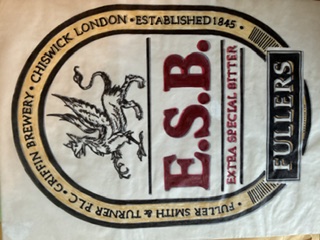
He had been bringing Fuller’s in since 1979. London Pride had come first, in cans, but ESB offered him something he thought would make a stronger impression.
In House’s view, Pride was a fine session beer, but perhaps not distinctive enough for the American market, especially at the colder temperatures at which Americans served it. ESB had more to announce itself with.
Even the name helped. House thought American drinkers would take to the initials: three letters were easier to remember and order than an explanation of English bitterness.
In his memoir The Cider King, House sums up the wait.
“We finally convinced Fullers to ship us ESB in 1987, nearly 10 years after we first started with the London Pride cans.”
For all the work involved in taking beer across an ocean, one of the hardest sales had been to its own brewery.
Selling it before he could pour it
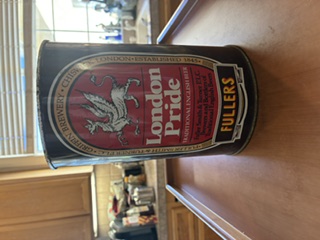
House had arrived in America in 1977, chasing an advertising job in San Francisco, only to find that the job came without a green card. Importing beer became another way forward. He chose a brewery that had been local to him in London.
London Pride cans entered the business in 1979 through a three-way partnership, Spectrum Imports. On 1 January 1980, Thames America Trading Company followed, operating from Sutter Street in San Francisco. Gordon A. Ponce documents those early years in “The Transatlantic Beer Bridge” at The Craft Beer Finder.
The work continued long after a shipment landed. House had to find wholesalers, win accounts and persuade bars that their customers would order the beer.
Some of that work was Angela Staines’s. House had first hired her in London, on the Kawasaki advertising account, and writes in the memoir that he “signed her up for promotional events and put her on a poster for Fuller’s London Pride beer” when he was its American importer. They later married.
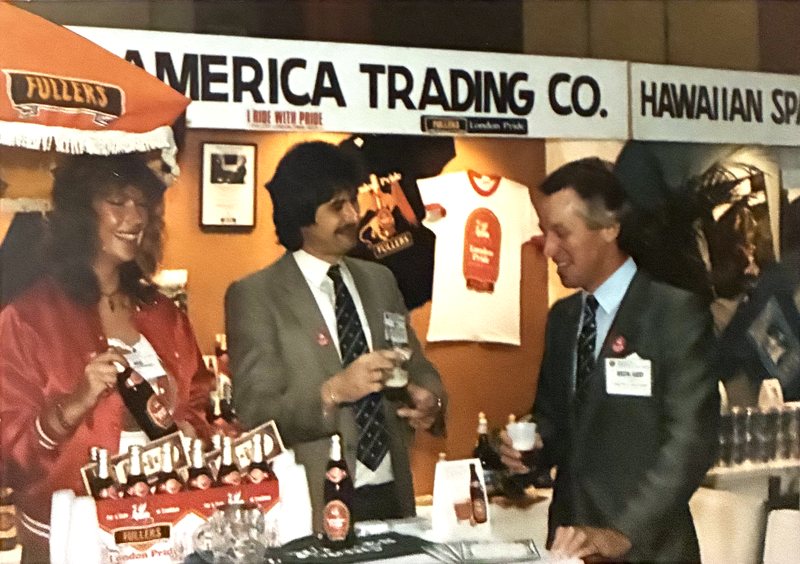
Among the people he met was Jeff Gunn of IDD, an English-born supplier of draught equipment. Gunn introduced him to Fritz Maytag of Anchor Brewing. House would later introduce Maytag to Anthony Fuller.
What the brewers borrowed
Fuller’s influence in North America went beyond the beer House could sell. At Horseshoe Bay it was a taste to aim for. At Goose Island it helped shape an ambition. At Firestone Walker it entered the fermentation tank.
The earliest of the three came before House’s Seattle draught launch. In 1982 John Mitchell and Frank Appleton opened Horseshoe Bay Brewery in British Columbia, described in the trade press the following year as Canada’s first microbrewery.
London Pride was the taste they aimed for, and Appleton asked Mitchell to get hold of some bottles of it so he could work out the recipe. In Brewing Revolution he says the yeast came from the national collection’s catalogue rather than from Chiswick.
John Hall, who founded Goose Island in Chicago in 1988, admired the relationship between Fuller’s and London. He wanted a brewery that could occupy a similar place in his own city.
“The dream for me was to be a Fuller’s, to represent Chicago like Fuller’s does in London.”
Hall said that in an interview of April 2016 with The Brewers Journal, in which he also expressed his respect for the brewery and for John Keeling.
Keeling’s own account makes the ESB connection more specific. Writing on Fuller’s blog in April 2018, in a post called “Coming to America”, he identified it as the beer that inspired Hall to start brewing. In the same passage, he recorded House’s introduction of London Pride to America in 1979, with ESB following in 1987.
For Firestone Walker, the connection was a choice between yeast cultures. Developing Double Barrel Ale, the Californian brewery ran trials and preferred a strain identified as Fuller’s ESB, despite the cleaner Chico alternative.
Co-founder David Walker says they chose it because it made the beer they liked best, and kept its character when they moved to a derivative of it.
Walker describes the later house yeast as still essentially a Fuller’s or London yeast. The trials and what came of them are in “Why Firestone Walker chose Fuller’s yeast”.
Something in the empties
Beer also travelled back, in containers that had already done one Atlantic crossing.
In House’s account, Fuller’s beer crossed in one-way kegs made by Van Leer, and once empty they had no journey home. Thames America sold them to Anchor, who filled them with its own beer.
The legacy, he says, was long. For years Anchor was not using the standard American Sankey keg fittings, because it was pouring out of Dutch barrels.
The journey the other way used different barrels. House had brought Maytag and Anthony Fuller together at a distributor party at the Mark Hopkins Hotel on Nob Hill, and he encouraged Fuller’s to import Anchor, suggesting they fill their own returnable 50-litre kegs with it.
Fuller’s arranged the trial. In House’s account Anchor’s beers went into three London pubs in late 1991: the Mawson Arms, the Dove and the Churchill Arms. We have followed what that did to British brewing in “Anchor Brewing’s British heritage”.
Ten years with Fuller’s
House puts the end of the agency in the middle of 1990, and says Grolsch Imports took it over with some nudging from Fritz Maytag. His account begins with a final visit to the Fuller’s boardroom.
House says Anthony Fuller proposed removing the Eastern and Midwest states from Thames America’s territory, with $50,000 in compensation. House refused, and the offer was withdrawn. Andrew Clarke, formerly of Watney’s American operation, then told Thames America that Grolsch would handle Fuller’s nationally. Fuller’s, House notes, was itself under contract to sell Grolsch in its pubs.
John Lambright managed the handover. In the end, House says, the $50,000 was paid anyway.
He was devastated by it. He had put his heart and soul into Fuller’s, and losing it was never only the loss of an agency. A letter from Fuller’s marketing director, Charles Williams, offered a different kind of recognition: House had started the brand in America, and that could never be taken away from him. He says it meant a great deal.
House draws two lessons from it. One is about the Mark Hopkins evening.
“Introducing a brewery owner to another brewery owner is never a good idea.”
The other is about the trade itself.
“When you import brands, you usually have about 10 years to market them. The best thing to do is do a moderate job, because if you do a bad job, they fire you. If you do a very good job, they get rid of you because they think somebody else can do better, because you’re a small company.”
Blackthorn cider went to Miller Brewing on a similar timetable. Thames America went on with Greene King Abbot Ale, Wexford Irish Cream and Old Suffolk Ale, and the cider business grew.
What came next
What Fuller’s put into American brewing outlasted the agency. John Hall built a Chicago brewery with a London one in mind, and the yeast Firestone Walker chose in its trials is still described as essentially a Fuller’s one.
Anthony Fuller, who was managing director of Fuller, Smith & Turner when House first brought London Pride to America, credits him with more than a brand. Because of House’s work, he says, “the name ‘ESB’ became the name of a type of beer used by a number of brewers across the United States of America.” He calls it “a unique achievement”, and says he is unaware of it “being equalled by others”.
House would eventually put his own name behind a drink he could make as well as sell: ACE cider. That story comes next.