Pride Unfiltered. The biggest launch in a generation?
Fuller’s put a cold, hazy, dry-hopped London Pride on keg, made it the official beer partner of the Pride in London parade, and then went quiet.
In February 2017 Fuller’s launched London Pride Unfiltered and called it, in its own words, “our biggest beer launch in a generation”. It meant taking the beer the brewery is known for, giving it a different finish, and sending it into bars where you would not expect to find the cask.
The Truman Brewery, 23 February 2017
The launch was at Craft Beer Rising, in the old Truman Brewery on Brick Lane, which is a pointed address for a Chiswick brewer’s big launch. MCA Insight reported the unveiling the next morning and carried the generation line. The Caterer put the claim in its proper frame: Pride had been brewed since 1959, and this was the first time since then that the name and the recipe had been used to widen the range.
Fuller’s did not simply put the beer on a bar. It hired the agency Ignis to build the stand, and Campaign reported a brief that punned on the name: bold and graphic, with nothing “stripped back or dialled down”. Pipework ran out of the bar into the room as part of the architecture, there were branded kegs and up-cycled furniture to sit on, a screen printing station where you could take an illustration off a limited edition can and put it on a t-shirt, and Le Bun serving sliders on the hour. It ran until the festival closed on 25 February.
Simon Dodd, then managing director of Fuller’s Beer Company, opened by reassuring everybody, in a statement the trade press carried in full: “London Pride on cask is a truly great beer and cask ale is, and always will be, the backbone of Fuller’s beer range.” Then the however, which named Frontier, the Fuller’s craft lager, as proof that the brewery had “relevance to different consumers and different drinking occasions”. The cask drinker was not the only drinker the brewery was for, and Dodd said so.
The release said the quiet part too. The beer had been “unashamedly designed to appeal to today’s younger consumer”, and was aimed at opening the brand up to “a new consumer and a new drinking occasion”. Then the sentence that sounds like it arrived from a different floor of the building. “The London Pride brand name has heritage and authenticity and we feel the time has come to leverage these qualities and bring London Pride to a more contemporary environment.”
What unfiltered meant
It was London Pride, with two things done to it and two things not done to it. Brewed to the same recipe, then dry hopped, then spun in a centrifuge and sent out neither filtered nor pasteurised, at 4.1% in thirty-litre kegs, poured at 4 to 6°C rather than at cellar temperature. Head brewer Georgina Young explained the reasoning to the Morning Advertiser: “By only using a centrifuge, we get a hazy beer but retain additional flavour to give London Pride Unfiltered more of the traditional character that you have in the cask beer than in the conventional London Pride keg version.” Fuller’s had bought the kit to do it, having “invested in our own facilities with a centrifuge and a new cross-flow”.
The hops are worth a note, because the accounts differ. The Caterer and the Morning Advertiser reported the beer as dry hopped with Target, and so did Fuller’s own page for Unfiltered, which had it “dry hopped with target for added character”. So does the annual report for that year, in the chief executive’s own review: “The beer is then dry hopped with additional Target hops.” The brewery’s launch blog is the one that tells it differently: Unfiltered “is still brewed with Northdown, Challenger, Target and Goldings hops, then dry hopped with Northdown and Challenger again”. The annual report and the brewery’s own product page both name Target; the launch blog names Northdown and Challenger instead. Target was in the recipe either way.
John Keeling, whom Fuller’s billed in its own blog as “the undisputed heavyweight champion of craft brewing”, did the explaining, and in a video posted that September he gave a better account of the beer than any of the coverage. He began with why touching Pride at all was a nervy business: it is the hardest beer Fuller’s has to make, he said, because it has so many fans that the smallest error brings letters and phone calls.
Young put the same difficulty as a compliment to the original, talking to MyLondon. “Like London Pride, it still tastes great when you are on your third pint,” she said, “and its creating this balance that takes real skill.”
Then the part the trade coverage left out. The cask and the unfiltered keg were brewed identically, with a little more hop going in during maturation, and they parted company only at the end. Cask Pride goes into the cask with finings, and it is the finings that clear it. Unfiltered used no finings at all. It went through a centrifuge instead. A centrifuge is not a filter, which is how a beer can be centrifuged and still be called Unfiltered, and it need not take everything with it. The more processing, Keeling said, the more chance of stripping something out: what you get is a brighter beer with a longer shelf life, which was not what they were after. “It will leave the beer hazy but with more flavour.”
The centrifuge itself is not a craft-era arrival at Chiswick. Keeling, writing for the New Zealand hop grower Wild About Hops about the brewery he joined, says that under a brewing director who was “very progressive in his use of science and technology”, Fuller’s “were the first or amongst the first to use centrifuges, to use conical fermenters in ale fermentation, and to invest in a QC laboratory”. Fuller’s was using centrifuges long before a hazy beer was something to advertise.
His reason for doing it at all was plainer than anything in the marketing. The market, he said, was moving much more towards keg, and he wanted a great beer in keg as well as a great beer in cask. That is a brewer answering the question. Everything else was an answer to a different one.
Young was more practical still about where it would go. Not everywhere: “I don’t think it’s going to be in every Fuller’s managed pub.” It was for the places that could not keep cask. “There is a place for this if they don’t have the cellar facilities for cask,” she said, and named hotels and weddings. She also had a drinker in mind, “the younger person who is really getting into beer at the moment”. A keg Pride goes where a cask Pride cannot, which is a duller reason than a craft beer launch on Brick Lane and a better one.
Fuller’s wrote the whole thing up in a house style you would not get from a brewery now. London Pride is an iconic pint, the blog says, and if it ain’t broke, don’t fix it, they say. “But what do they know?” It promised a beer for “drinkers who are interested in trying craft beers”, in “a slightly different style of pub and bar” from the one where you would find the cask. And in the middle of reassuring everybody that the recipe had not changed, it typed “London Filtered is not to be confused with London Pride Original”, which is the most honest sentence on the page.
Bow Lane, 8 December 2017
This is the beer doing the job it was built for, nine months after Brick Lane and seven before the parade: the Fine Line on Bow Lane, a Fuller’s house beside St Mary-le-Bow, three weeks before Christmas.
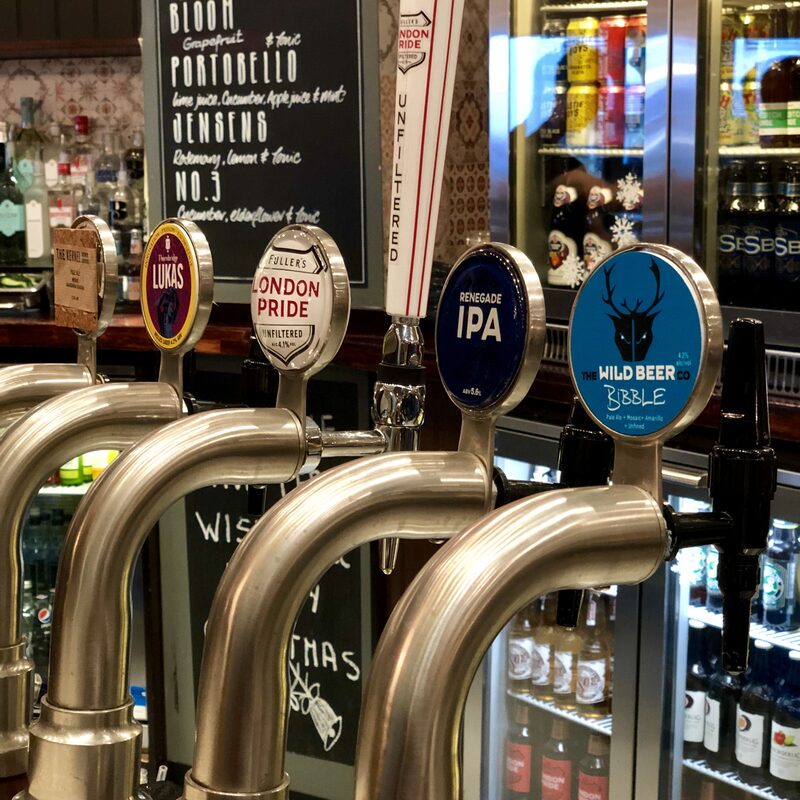
The board that lunchtime is the better document.
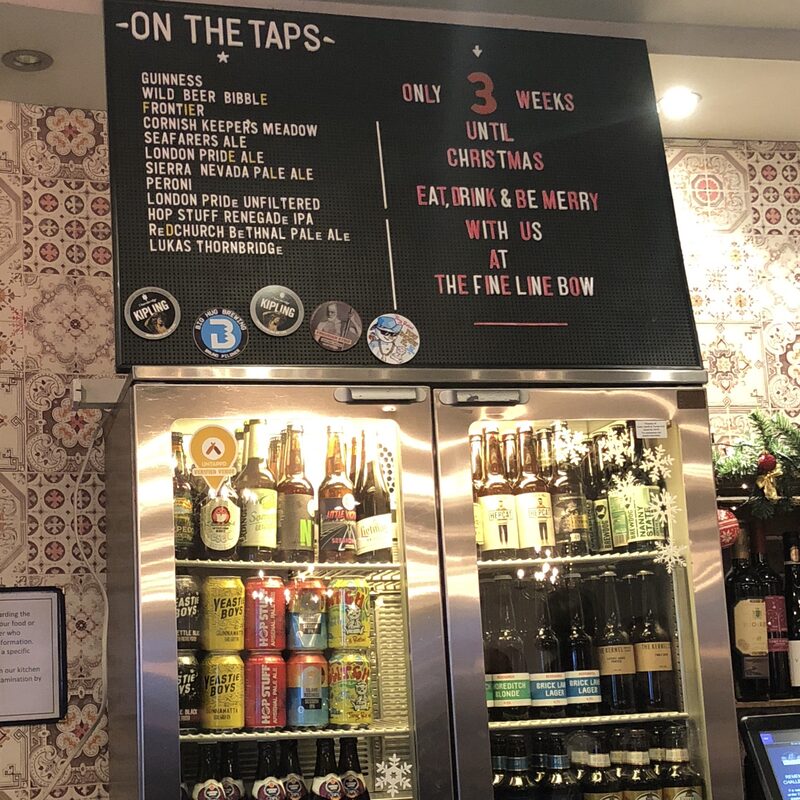
London Pride and London Pride Unfiltered, both on, three lines apart. Frontier, the craft lager Dodd had named in the launch statement as the proof that Fuller’s had relevance to different drinkers. Seafarers. And Keeper’s Meadow, the seasonal cider that year’s annual report singled out among Cornish Orchards’ new products. Four of the things the Fuller’s Beer Company was telling its shareholders about, on one chalkboard, in one of its own pubs, with three weeks to Christmas.
Whatever happened afterwards, the thing was real and it was on the wall. The Fine Line is The Saint now.
The parade, 7 July 2018
The most visible moment came the following summer. Unfiltered was the official beer partner of the Pride in London parade on 7 July 2018, under a Pride Loves Pride campaign built by the agency Recipe. Fuller’s pubs in and around the route, as the trade coverage reported that week, were to get the glassware, the keg lens, the beer mats and the staff T-shirts: nine of them by the brewery’s own count: the Iron Duke, the Jack Horner, the Ship in Wardour Street, the Red Lion in Mayfair, the Sun & 13 Cantons, the Lamb and Flag, the Roundhouse, the Red Lion in Westminster and the Admiralty. The trade coverage listed eight and lost one of the Red Lions on the way.
It went outside the pubs as well. At Oxford Circus two 48-sheet cross-track posters ran side by side, as the campaign was announced: “You wait hundreds of years to see a gay beer ad” on the first, and “And then two come along” on the second. The social posts ran to “You won’t catch us coming out for a day, we’re London Pride 365 days a year”.
Matt Waller, the creative director at Recipe, gave the logic of it away in his own quote: “London Pride Unfiltered and Pride in London are the perfect partnership, (if you don’t believe us just Google London Pride.)” The beer was, he said, “a young and vibrant brand reaching out to an audience that has often been overlooked by traditional brewers”.
Fuller’s own account of it says the same thing in a suit. Jane Jones, then its director of marketing: “Pride in London is a great fit for Pride, but it doesn’t just share the same name; we share the same values of authenticity and independence, being a long-standing part of the fabric of London’s rich and varied culture since 1959.”
The good bit was the voucher. Brand ambassadors were to hand out two-part vouchers, and the artwork ran with the announcement: a beer mat, “Share Some Pride” on the front in the Fuller’s shield with the word Pride in rainbow letters, and the back split down the middle, each half printed upside down to the other so that two people could read it at once. Each half says the same thing. “Find someone with the other half of this voucher to share 2 free pints of London Pride Unfiltered.”
Valid to 15 July, redeemable in Fuller’s pubs, a pint of Unfiltered or of ordinary Pride on each half, or a soft drink instead. You could not redeem it on your own. You had to find someone with the other half. For a beer at a Pride parade, that is a small piece of design, and somebody had plainly thought about the occasion and not only the beer.
And then?
Unfiltered found drinkers. Untappd has it at 3.33 from 3,584 ratings as of November 2026, and the page now carries the line it carries for the dead: “This beer is no longer being produced by the brewery.” It supplies neither a date nor an explanation. It tells you nothing about how well it sold. We have not established that.
Some people were paying attention. By May 2018 it was in 330ml cans in the shops as well as on keg, and the Real Ale Craft Beer channel reviewed one of those cans outdoors on a slipway, with a drone, having very nearly crashed the drone into the sea and having had to fish the can out of it. The verdict was nine out of ten: more depth than the original, better balanced, the hops further forward, and better than regular London Pride “without a shadow of a doubt”. One reviewer is one reviewer. But the beer that stopped being made was not a beer nobody liked.
Put the dates in a row and the trail runs past the parade. Launched on Brick Lane in February 2017. Official beer partner of the Pride in London parade in July 2018. In August 2018 the brand’s own posts were still promoting the cans in Waitrose, and its page on the Fuller’s website was still up in April 2019. On 25 January 2019 Fuller’s announced the sale of its beer business to Asahi, the Griffin Brewery with it, a £250 million deal it put down to “structural changes to the beer industry” and to being squeezed, as a mid-sized brewer, between the global brewers and the two thousand smaller ones. In March the head brewer went: Georgina Young, who had explained Unfiltered to the trade press two years earlier, left for Bath Ales. The Morning Advertiser reported the sale as completed at the end of April 2019. In August 2019 the Fuller’s pub finder still offered Unfiltered as a filter. And on 9 October 2019 the Butchers Arms in Headington told its followers: “London Pride Unfiltered back on tap, while stocks last!”
None of that proves anybody was still brewing it. A listing can outlive a beer by months, and a pub can pour a beer after the brewing has stopped. What it does show is that Unfiltered was still being offered on tap more than five months after the sale. When the brewing stopped is the part nobody has said. We have found no announcement, no trade report and no farewell post.
The annual reports, 2017 to 2019
What there is, instead, is the beer’s life as Fuller’s told it in its own annual reports, three of them, and it reads like a short biography.
2017, the year of the launch: “Launched London Pride Unfiltered at Craft Beer Rising”, logged under progress, with the priority for the coming year set as “Grow sales of London Pride Unfiltered”. The chief executive’s review that year is warm about it. Early signs “very positive”, and the brewery “confident the beer will bring London Pride to a whole new audience”.
2018, the first full year: one clause, in a list of points of difference. The Fuller’s & Friends box set was exclusive to Waitrose, “and, again for Waitrose, London Pride Unfiltered in cans”.
2019, signed off by Simon Emeny on 24 July: “Meanwhile, London Pride Unfiltered gained a listing in Waitrose and was the Official Beer of Pride in London. Social feeds grew by 314% and, combined with an excellent seasonal calendar and the second series of Fuller’s & Friends, The Fuller’s Beer Company was perfectly placed for its sale to Asahi Europe Ltd.”
The last time Fuller’s mentions Unfiltered in its reports, it is among the achievements of the beer company in the year of its sale. A Waitrose listing and a Pride sponsorship were worth reporting. Whether they translated into sales is another question, and one the annual reports do not answer.
That needs a caveat, and it is one in Fuller’s favour. After April 2019 these were the reports of the pub company that had sold the brewing business. Unfiltered’s absence from later reports cannot tell us what happened to production under Asahi.
One oddity, for anyone who goes looking. The 2019 report’s table of progress gives Unfiltered a June 2018 launch date. The brewery’s 2017 report records its launch at Craft Beer Rising in February 2017. Both cannot describe the original launch.
A beer that a brewery calls its biggest launch in a generation usually gets an obituary. This one got a sentence on a check-in app.
London Pride @home
Nine years on, Pride has been adapted again, this time for a kitchen counter, from concentrate, with a different yeast. What has to stay the same for it still to be Pride?
Why Firestone Walker chose Fuller’s yeast
The Pride yeast that went to California, and the one house strain behind every Fuller’s beer.
PINtPOINT shows where drinkers have recently logged a beer, and how long ago, from Untappd. It also keeps the ones that have stopped.